
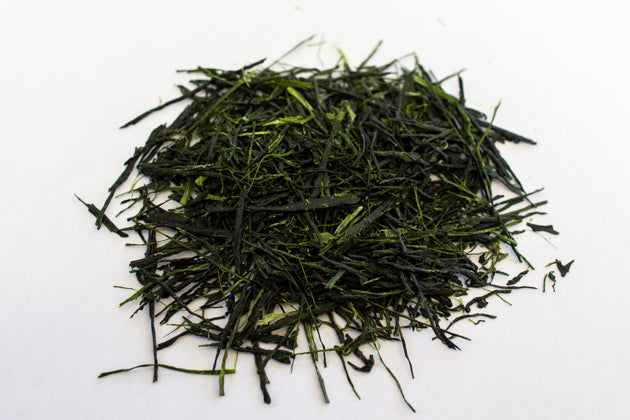
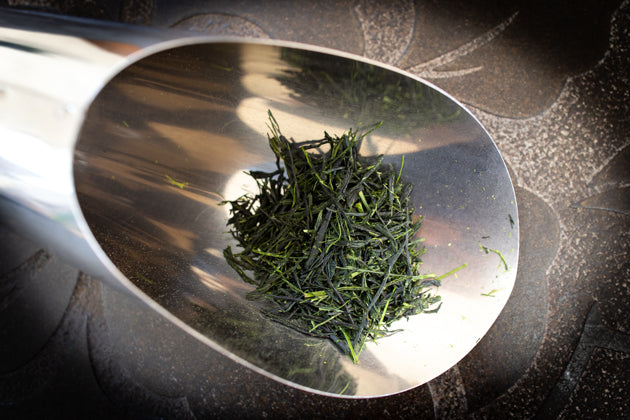
Gyokuro Yabukita 100g
Gyokuro Yabukita is an Asahina Gyokuro, grown in tea gardens along the Asahina River in Okabe, Fujieda City, Shizuoka Prefecture.
Anyone who has walked along a riverbank at night will know the feeling: once the sun goes down, the temperature near a river drops sharply.
During the day, tea plants take in carbon dioxide and photosynthesize to produce energy. At night the reverse happens: they take in oxygen and consume that energy. In areas where nights are cold, the plant's rate of consumption slows dramatically, so the tea grows slowly, over a long stretch of time. This is why riverside tea gardens so often produce excellent tea, and Asahina Gyokuro is no exception.

What is Hon-Gyokuro?
The tea used for Gyokuro is shade-grown. A characteristic of shaded tea, Gyokuro or otherwise, is that the plant produces large amounts of chlorophyll in order to photosynthesize more efficiently.
As a result, shade-grown tea takes on a deep green color. Gyokuro gardens are generally covered with kanreisha, a black plastic mesh sheeting. Today, almost all Gyokuro gardens are shaded with this kanreisha. By contrast, the Gyokuro known as Hon-Gyokuro ("true Gyokuro") is shaded with straw. Hon-Gyokuro is now extremely rare, a scarce thing regardless of the region. The point of covering with straw is this: when it rains, water soaks into the straw and minerals from the straw drip down onto the soil. The tea plants absorb these straw-derived minerals, so compared with Gyokuro from gardens shaded with plastic mesh, Hon-Gyokuro has a fuller aftertaste and a longer finish. That said, quality also depends on the quality of the straw, so not only the tea garden but the rice paddy that grows the straw contributes to the result.

Above: a Hon-Gyokuro garden shaded with straw. Below: a Gyokuro garden shaded with plastic mesh, the type commonly seen in recent years. 
A single-cultivar Gyokuro
Gyokuro is a tea that producers and merchants usually sell as a blend of several cultivars.
The purpose of blending is to balance the flavor by combining, say, a full-bodied cultivar, a cultivar rich in umami, and a cultivar with a long finish.
This product, Gyokuro Yabukita, is by contrast a Gyokuro made from the Yabukita cultivar alone. Its hallmarks are a long finish and a full, substantial aftertaste. Where Gyokuro typically has a distinctive nori-like, seaweed aroma, this tea is notable for its fragrance, too: a striking floral note. By committing to a single cultivar rather than a blend, we sought a clean, refreshing drinking quality that umami-focused Gyokuro does not usually offer. 
Surprisingly delicious brewed with boiling water
If you look up how to brew Gyokuro in books or online, the standard advice is to let boiled water cool to around 50 to 60°C and steep the leaves slowly for several minutes. This method is designed to hold back the extraction of polyphenols and caffeine while drawing out theanine, the umami component. Gyokuro brewed this way tastes like a rich, umami-laden broth. I do not reject this method, but personally I find umami-heavy Gyokuro a little heavy for everyday drinking. What I would like to suggest instead is brewing with boiling water. Steeping at high temperature draws out the polyphenols and aromatic compounds. The result is a clean, refreshing taste, and alongside the floral fragrance you can enjoy a sweet, milky aroma. That milky note calls to mind a fine Taiwanese Jin Xuan oolong, especially one from a high-elevation garden. You may worry that boiling water will make it bitter. Try it anyway, even if you are skeptical. Surprisingly, it is not bitter at all. 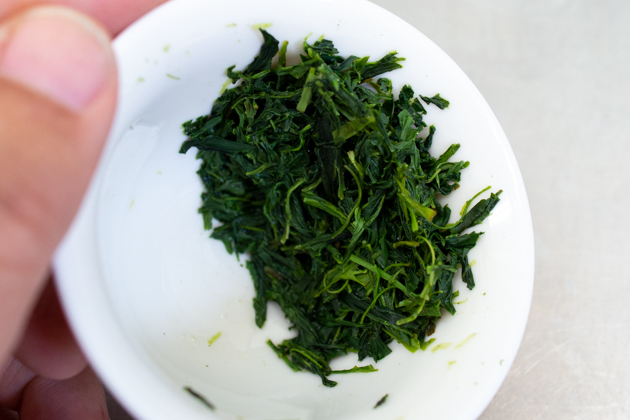
How to brew it well: high temperature, short steeps
1. Preheat the teapot with boiling water for 10 seconds.
2. Add 3 to 5g of tea leaves.
3. Pass boiling water over the leaves for a few seconds to preheat them.
4. 1st infusion: boiling water, 5 to 10 seconds.
5. 2nd infusion: boiling water, a few seconds.
6. 3rd infusion: boiling water, a few seconds.
7. Combine the 1st through 3rd infusions to adjust the strength.
Until you get used to it, you can skip the preheating in step 3. In that case, steep the first infusion for 10 seconds. If you did preheat the leaves, 5 seconds is enough. Ideally, choose a teapot about one third the volume of your pitcher (cha hai) so that all three infusions can be combined in it.
Choose options